> ## Documentation Index
> Fetch the complete documentation index at: https://docs.fentufsm.com/llms.txt
> Use this file to discover all available pages before exploring further.
# Complaints
> Manage warranty claims and campaign work
## Overview
Complaints in Fentu FSM are warranty claims and manufacturer campaign work attached to service requests (Cases). They track warranty repairs, equipment recalls, manufacturer-mandated updates, and other work where costs are covered by manufacturers or held for customer decision.
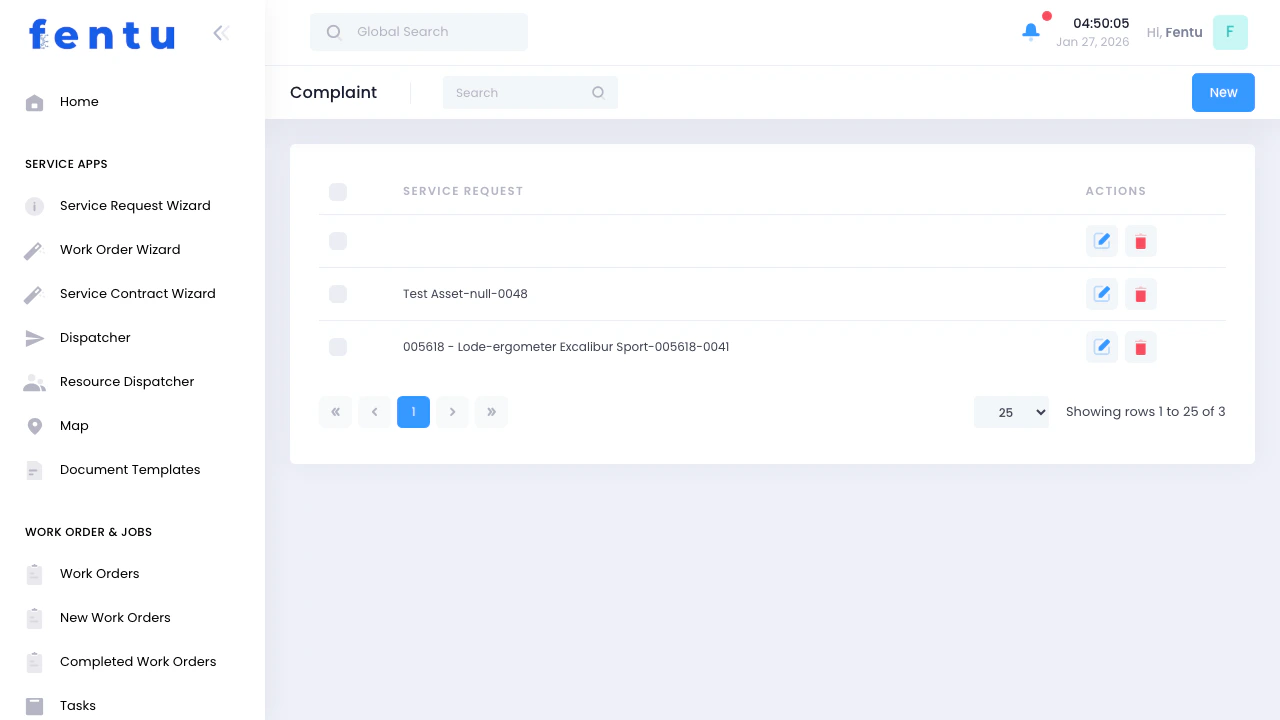 Despite the name "Complaints," this module handles warranty work and campaigns, not customer service complaints. It tracks work where you're repairing equipment under manufacturer warranty or performing manufacturer-mandated recalls and updates.
## When to Use Complaints
Create complaint records when you need to:
* Process warranty repairs covered by manufacturers
* Perform manufacturer recall or campaign work
* Track equipment warranty claims
* Handle work held pending customer decision (interest hold)
* Document warranty parts and labor
* Generate warranty claims to manufacturers
* Link warranty work to service requests
***
## Complaint Types
Fentu FSM supports four types of complaints:
| Type | When to Use | Who Pays |
| ---------------------- | ---------------------------------------------------------------------------------- | -------------------------- |
| **Warranty** | Repairs covered under manufacturer warranty | Manufacturer |
| **Campaign** | Manufacturer recalls, safety updates, or mandated modifications | Manufacturer |
| **Equipment Warranty** | Equipment-specific warranty claims (extended warranty, equipment protection plans) | Warranty provider |
| **Interest Hold** | Work requiring customer decision or approval before proceeding | Pending (customer decides) |
"Complaint" is a technical term in FSM software for warranty/campaign work. It does NOT refer to customer service complaints or dissatisfaction issues.
***
## Complaints List View
### Key Features
Every complaint links to a Case (service request). The case is the customer-facing service request; the complaint is the underlying warranty claim.
Quickly see whether work is warranty, campaign, equipment warranty, or interest hold.
Track complaint status: Open (pending work), Quoted (estimated), or Closed (completed).
Each complaint gets a unique job number for tracking warranty claims with manufacturers.
### List Columns
| Column | Description |
| ----------------- | ------------------------------------------------------------------------------------------- |
| **Case** | Service request this complaint is attached to (click to view case details) |
| **Name** | Descriptive name: "Warranty Repair - Machine Compressor" or "Campaign Work - Safety Recall" |
| **Planned Date** | When warranty work is scheduled |
| **Description** | What's being repaired under warranty or campaign |
| **Job Number** | Unique identifier for warranty claim (WR-001, CP-002, etc.) |
| **Customer** | Which customer's equipment is being serviced |
| **Warranty Type** | Warranty, Campaign, Equipment Warranty, or Interest Hold |
| **Status** | Open, Quoted, or Closed |
| **Actions** | View details, edit, attach assets/parts, close complaint |
***
## Creating a Complaint
Complaints are typically created from service requests when you identify warranty-covered work:
Customer reports an issue through a Case (service request).
Technician determines the problem and checks warranty coverage.
If work is covered by warranty or is a campaign, create a complaint attached to the case.
Choose: Warranty, Campaign, Equipment Warranty, or Interest Hold.
Name, description, planned date, job number.
Attach the equipment being repaired under warranty.
Assign technicians to perform warranty work.
Add warranty parts being replaced.
Include manufacturer-required inspection checklists or procedures.
Complaint is linked to case and ready for scheduling.
***
## Complaint Detail View
Despite the name "Complaints," this module handles warranty work and campaigns, not customer service complaints. It tracks work where you're repairing equipment under manufacturer warranty or performing manufacturer-mandated recalls and updates.
## When to Use Complaints
Create complaint records when you need to:
* Process warranty repairs covered by manufacturers
* Perform manufacturer recall or campaign work
* Track equipment warranty claims
* Handle work held pending customer decision (interest hold)
* Document warranty parts and labor
* Generate warranty claims to manufacturers
* Link warranty work to service requests
***
## Complaint Types
Fentu FSM supports four types of complaints:
| Type | When to Use | Who Pays |
| ---------------------- | ---------------------------------------------------------------------------------- | -------------------------- |
| **Warranty** | Repairs covered under manufacturer warranty | Manufacturer |
| **Campaign** | Manufacturer recalls, safety updates, or mandated modifications | Manufacturer |
| **Equipment Warranty** | Equipment-specific warranty claims (extended warranty, equipment protection plans) | Warranty provider |
| **Interest Hold** | Work requiring customer decision or approval before proceeding | Pending (customer decides) |
"Complaint" is a technical term in FSM software for warranty/campaign work. It does NOT refer to customer service complaints or dissatisfaction issues.
***
## Complaints List View
### Key Features
Every complaint links to a Case (service request). The case is the customer-facing service request; the complaint is the underlying warranty claim.
Quickly see whether work is warranty, campaign, equipment warranty, or interest hold.
Track complaint status: Open (pending work), Quoted (estimated), or Closed (completed).
Each complaint gets a unique job number for tracking warranty claims with manufacturers.
### List Columns
| Column | Description |
| ----------------- | ------------------------------------------------------------------------------------------- |
| **Case** | Service request this complaint is attached to (click to view case details) |
| **Name** | Descriptive name: "Warranty Repair - Machine Compressor" or "Campaign Work - Safety Recall" |
| **Planned Date** | When warranty work is scheduled |
| **Description** | What's being repaired under warranty or campaign |
| **Job Number** | Unique identifier for warranty claim (WR-001, CP-002, etc.) |
| **Customer** | Which customer's equipment is being serviced |
| **Warranty Type** | Warranty, Campaign, Equipment Warranty, or Interest Hold |
| **Status** | Open, Quoted, or Closed |
| **Actions** | View details, edit, attach assets/parts, close complaint |
***
## Creating a Complaint
Complaints are typically created from service requests when you identify warranty-covered work:
Customer reports an issue through a Case (service request).
Technician determines the problem and checks warranty coverage.
If work is covered by warranty or is a campaign, create a complaint attached to the case.
Choose: Warranty, Campaign, Equipment Warranty, or Interest Hold.
Name, description, planned date, job number.
Attach the equipment being repaired under warranty.
Assign technicians to perform warranty work.
Add warranty parts being replaced.
Include manufacturer-required inspection checklists or procedures.
Complaint is linked to case and ready for scheduling.
***
## Complaint Detail View
 The complaint detail/edit page provides comprehensive tools for managing warranty claims:
### Detail View Sections
Core details including:
* **Case** - Service request this complaint is attached to
* **Name** - Descriptive name for the warranty claim
* **Planned Date** - When work is scheduled
* **Description** - Detailed explanation of the warranty issue
* **Job Number** - Reference number for warranty claim
* **Customer** - Which customer's equipment
* **Warranty Type** - Warranty, Campaign, Equipment Warranty, or Interest Hold
* **Status** - Open, Quoted, or Closed
Equipment being repaired under warranty:
* Asset name and type
* Serial number
* Warranty coverage details
* Installation date (to verify warranty period)
**Why this matters:** Need to prove equipment is under warranty. Serial numbers and purchase dates are essential for manufacturer warranty claims.
Technicians performing warranty work:
* Technician name
* Role in complaint resolution
* Time spent (for warranty labor claims)
**Labor Claims:** Track technician hours to submit labor reimbursement claims to manufacturers.
Warranty parts being replaced:
* Part number and description
* Quantity
* Asset the part belongs to
* Whether part is warranty-covered
**Parts Claims:** Document failed parts for warranty reimbursement from manufacturers. Keep failed parts for manufacturer inspection if required.
Manufacturer-required inspection procedures:
* Pre-repair checklists
* Post-repair verification
* Campaign completion documentation
* Safety inspection forms
**Compliance:** Manufacturers often require specific procedures be followed and documented for warranty coverage.
Supporting documentation:
* Photos of failed parts
* Warranty certificates
* Purchase receipts
* Manufacturer campaign bulletins
* Inspection reports
**Claim Support:** Documentation proves warranty coverage and supports reimbursement claims.
***
## Complaint Fields
### Basic Information
| Field | Description |
| ---------------- | ------------------------------------------------------------------------------------------------------------- |
| **Case** | Service request this complaint is attached to. Required. Links to the Case (service request) module. |
| **Name** | Descriptive name for warranty claim. Be specific: "Warranty Repair - Compressor Failure" not just "Warranty". |
| **Planned Date** | When warranty work will be performed. |
| **Description** | Detailed explanation of what failed, symptoms, diagnosis, and what warranty covers. |
| **Job Number** | Unique reference number. Used for tracking with manufacturers (WR-001, CP-002, EW-003, etc.). |
| **Customer** | Which customer owns the equipment. Auto-populated from case. |
### Warranty Information
| Field | Description |
| --------------------- | ----------------------------------------------------------------------------------------------------------------------------------------------------------------------------------------------------------------------------------------------------------------------- |
| **Warranty Type** | Select type:
The complaint detail/edit page provides comprehensive tools for managing warranty claims:
### Detail View Sections
Core details including:
* **Case** - Service request this complaint is attached to
* **Name** - Descriptive name for the warranty claim
* **Planned Date** - When work is scheduled
* **Description** - Detailed explanation of the warranty issue
* **Job Number** - Reference number for warranty claim
* **Customer** - Which customer's equipment
* **Warranty Type** - Warranty, Campaign, Equipment Warranty, or Interest Hold
* **Status** - Open, Quoted, or Closed
Equipment being repaired under warranty:
* Asset name and type
* Serial number
* Warranty coverage details
* Installation date (to verify warranty period)
**Why this matters:** Need to prove equipment is under warranty. Serial numbers and purchase dates are essential for manufacturer warranty claims.
Technicians performing warranty work:
* Technician name
* Role in complaint resolution
* Time spent (for warranty labor claims)
**Labor Claims:** Track technician hours to submit labor reimbursement claims to manufacturers.
Warranty parts being replaced:
* Part number and description
* Quantity
* Asset the part belongs to
* Whether part is warranty-covered
**Parts Claims:** Document failed parts for warranty reimbursement from manufacturers. Keep failed parts for manufacturer inspection if required.
Manufacturer-required inspection procedures:
* Pre-repair checklists
* Post-repair verification
* Campaign completion documentation
* Safety inspection forms
**Compliance:** Manufacturers often require specific procedures be followed and documented for warranty coverage.
Supporting documentation:
* Photos of failed parts
* Warranty certificates
* Purchase receipts
* Manufacturer campaign bulletins
* Inspection reports
**Claim Support:** Documentation proves warranty coverage and supports reimbursement claims.
***
## Complaint Fields
### Basic Information
| Field | Description |
| ---------------- | ------------------------------------------------------------------------------------------------------------- |
| **Case** | Service request this complaint is attached to. Required. Links to the Case (service request) module. |
| **Name** | Descriptive name for warranty claim. Be specific: "Warranty Repair - Compressor Failure" not just "Warranty". |
| **Planned Date** | When warranty work will be performed. |
| **Description** | Detailed explanation of what failed, symptoms, diagnosis, and what warranty covers. |
| **Job Number** | Unique reference number. Used for tracking with manufacturers (WR-001, CP-002, EW-003, etc.). |
| **Customer** | Which customer owns the equipment. Auto-populated from case. |
### Warranty Information
| Field | Description |
| --------------------- | ----------------------------------------------------------------------------------------------------------------------------------------------------------------------------------------------------------------------------------------------------------------------- |
| **Warranty Type** | Select type:
• **Warranty** - Standard manufacturer warranty
• **Campaign** - Manufacturer recall or mandated update
• **Equipment Warranty** - Extended warranty or equipment protection plan
• **Interest Hold** - Work pending customer decision |
| **Is Under Warranty** | Checkbox confirming warranty coverage verified. |
| **Status** | Current state:
• **Open** - Complaint created, work pending
• **Quoted** - Estimate provided (if any customer portion)
• **Closed** - Work completed, claim submitted |
### Record Information
| Field | Description |
| ----------------- | ---------------------------------------------- |
| **Record Owner** | Who's responsible for managing this complaint. |
| **Created By/At** | Who created the complaint and when. |
| **Updated By/At** | Last modification details. |
***
## Understanding Complaint Types
### Warranty
Standard manufacturer warranty covering defects in materials or workmanship:
**Example Scenarios:**
* Compressor fails within warranty period
* Control board defect under manufacturer warranty
* Motor bearing failure covered by warranty
**Process:**
1. Verify equipment is within warranty period
2. Diagnose failure (must be covered defect, not abuse/neglect)
3. Create complaint and document issue
4. Obtain warranty parts from manufacturer
5. Complete repair and submit warranty claim
6. Get reimbursed for labor and parts
**Documentation Needed:**
* Serial number and purchase date
* Photos of failed part
* Diagnostic notes proving defect (not abuse)
* Repair completion documentation
### Campaign
Manufacturer-mandated recalls, safety updates, or modifications:
**Example Scenarios:**
* Safety recall for elevator components
* Manufacturer update to fix known issue
* Mandatory software update
* Product improvement campaign
**Process:**
1. Manufacturer issues campaign bulletin
2. Identify affected equipment at customers
3. Create complaints for all affected units
4. Schedule campaign work with customers
5. Complete modifications per manufacturer specs
6. Submit completion documentation to manufacturer
7. Get reimbursed per campaign terms
**Documentation Needed:**
* Campaign bulletin from manufacturer
* Before photos
* After photos
* Completion checklist
* Customer sign-off
### Equipment Warranty
Extended warranties or equipment protection plans beyond manufacturer warranty:
**Example Scenarios:**
* Extended warranty purchased with equipment
* Third-party equipment protection plan
* Service contract with equipment coverage
**Process:**
1. Verify coverage with warranty provider
2. Obtain claim authorization number
3. Create complaint and document issue
4. Complete repair
5. Submit claim to warranty provider
6. Get reimbursed per contract terms
**Documentation Needed:**
* Warranty contract or policy number
* Authorization/claim number from provider
* Detailed repair description
* Parts receipts
* Labor hours
### Interest Hold
Work identified but held pending customer decision or approval:
**Example Scenarios:**
* Repair not covered by warranty, awaiting customer approval
* Found additional issue during warranty work
* Customer requested delay for budget reasons
* Pending parts availability or customer scheduling
**Process:**
1. Identify issue during service call
2. Create interest hold complaint
3. Provide quote to customer if not covered
4. Wait for customer decision
5. Convert to work order when approved or close if declined
**Documentation Needed:**
* Quote for customer approval
* Customer communication log
* Reason for hold
***
## Linking Complaints to Cases
The Case → Complaint relationship is fundamental:
**Case (Service Request):**
* Customer-facing record of the service request
* "My compressor isn't working"
* Tracks customer communication and satisfaction
**Complaint (Warranty Claim):**
* Internal record of warranty work
* "Compressor failure under warranty"
* Tracks warranty claim with manufacturer
**Why Separate:**
* Customer sees Case status ("we're working on it")
* You see Complaint details (warranty claim process)
* Keeps warranty admin separate from customer communication
* One case may generate multiple complaints (found multiple warranty issues)
***
## Complaint Actions
Update complaint information, status, planned date, or description.
Link equipment being repaired under warranty claim.
Add resources (technicians) performing warranty work.
Document warranty parts being replaced.
Link manufacturer-required inspection procedures.
Add photos, receipts, campaign bulletins, or warranty certificates.
Move complaint through workflow: Open → Quoted → Closed.
Jump to the parent service request (case).
***
## Tips and Best Practices
Check warranty coverage BEFORE creating complaint:
* Is equipment within warranty period?
* Is the issue a covered defect?
* Are there any warranty exclusions?
* Do you have proof of purchase?
Creating warranty complaints for non-covered work wastes time and creates rejected claims.
Warranty claims live or die on documentation:
* Photos of failed parts (multiple angles)
* Serial number and model number photos
* Diagnostic test results
* Before and after photos
* Customer sign-off
More documentation = higher claim approval rate.
Keep warranty parts separate from regular inventory:
* Use different part numbers or stock locations
* Track warranty part costs separately
* Store failed parts for manufacturer inspection
* Don't throw away failed parts until claim is approved
Manufacturers often require failed parts be returned or available for inspection.
Use consistent job number format:
* WR-#### for Warranty Repairs
* CP-#### for Campaign work
* EW-#### for Equipment Warranty
* IH-#### for Interest Hold
Standardized numbering makes tracking and reporting easier.
Don't delay warranty claim submissions:
* Submit within manufacturer timeframes (usually 30-90 days)
* Late claims get rejected
* Track submission deadlines
* Follow up on pending claims
Prompt submission maximizes reimbursement.
Each manufacturer has specific requirements:
* Pre-authorization needed?
* What documentation required?
* How to obtain warranty parts?
* Labor rate and time limits?
* Where to submit claims?
Keep manufacturer warranty guides accessible to technicians.
Monitor warranty claim metrics:
* Approval rate (target: 90%+)
* Average reimbursement amount
* Time to payment
* Rejection reasons
Low approval rates indicate documentation or process problems.
Interest hold is for genuine holds, not procrastination:
* Customer needs time to decide
* Waiting for customer budget approval
* Parts availability issue
* Customer scheduling conflict
Don't use interest hold for internal delays.
***
## Common Questions
"Complaint" is industry terminology in FSM software for warranty claims and manufacturer campaign work. The term comes from manufacturing where "complaints" refer to product defects reported back to manufacturers.
This is NOT the same as customer service complaints or dissatisfaction issues.
**Yes**, if you're submitting a warranty claim to a manufacturer. Creating complaints allows you to:
* Track warranty work separately from regular work
* Document parts and labor for reimbursement
* Monitor warranty claim success rates
* Generate warranty reports
If you're NOT claiming reimbursement (goodwill warranty work you're absorbing), you may skip creating a complaint and just note it in the work order.
**Case (Service Request)** = Customer-facing service request ("My equipment is broken")
**Complaint** = Internal warranty claim attached to the case ("Compressor failure covered by warranty")
One case can have multiple complaints if multiple warranty issues are found. Example:
* **Case:** "Machine not working"
* **Complaint 1:** Warranty - Compressor failure
* **Complaint 2:** Warranty - Control board defect
Check these criteria:
1. **Within Warranty Period** - Check purchase date and warranty length
2. **Covered Defect** - Failure due to defect, not abuse/neglect/wear
3. **Proper Installation** - Equipment installed per manufacturer specs
4. **Proper Maintenance** - Regular maintenance performed as required
5. **No Unauthorized Modifications** - No changes that void warranty
When in doubt, contact manufacturer warranty department before creating complaint.
**Campaign** is manufacturer-initiated work:
* Safety recalls
* Product improvements for known issues
* Mandatory updates or modifications
* Field service bulletins
Manufacturers contact you or customers directly about campaigns. You create campaign complaints to track completion and get reimbursed for campaign work.
**Typical process:**
1. **Contact manufacturer** for warranty parts
2. Manufacturer ships parts at no charge (or credits your account)
3. You use parts to complete repair
4. Link parts to complaint
5. Submit complaint with part documentation
6. Get reimbursed for labor
**If you must purchase parts:**
* Keep receipts
* Document why you couldn't get from manufacturer (emergency, not available, etc.)
* Submit for reimbursement with claim
* Approval not guaranteed if you didn't follow manufacturer process
**Common rejection reasons:**
* Insufficient documentation
* Equipment out of warranty
* Failure due to abuse/neglect (not defect)
* Improper installation voided warranty
* Claim submitted too late
* Required pre-authorization not obtained
**If rejected:**
* Understand reason
* Appeal if you believe rejection is wrong (provide additional documentation)
* If upheld, charge customer for work (convert to regular billable work)
* Learn from rejection to improve future claims
**Interest Hold** is a holding status:
**Scenario:** During warranty repair, you find additional non-warranty issue requiring \$500 in parts.
**Process:**
1. Create Interest Hold complaint for additional work
2. Provide quote to customer
3. Customer decides: approve, deny, or defer
4. If approved: convert to work order and complete
5. If denied: close interest hold, do warranty work only
6. If deferred: keep open until customer ready
**Why separate complaint?** Keeps warranty claim clean and documents that you identified additional work needing customer approval.
***
## Related Documentation
Complaints are created from service requests (Cases).
Complaint work generates work orders for technician completion.
Link assets to complaints for warranty tracking.
Track warranty parts separately in inventory.