> ## Documentation Index
> Fetch the complete documentation index at: https://docs.fentufsm.com/llms.txt
> Use this file to discover all available pages before exploring further.
# Material Requests
> Requesting parts and materials for work orders
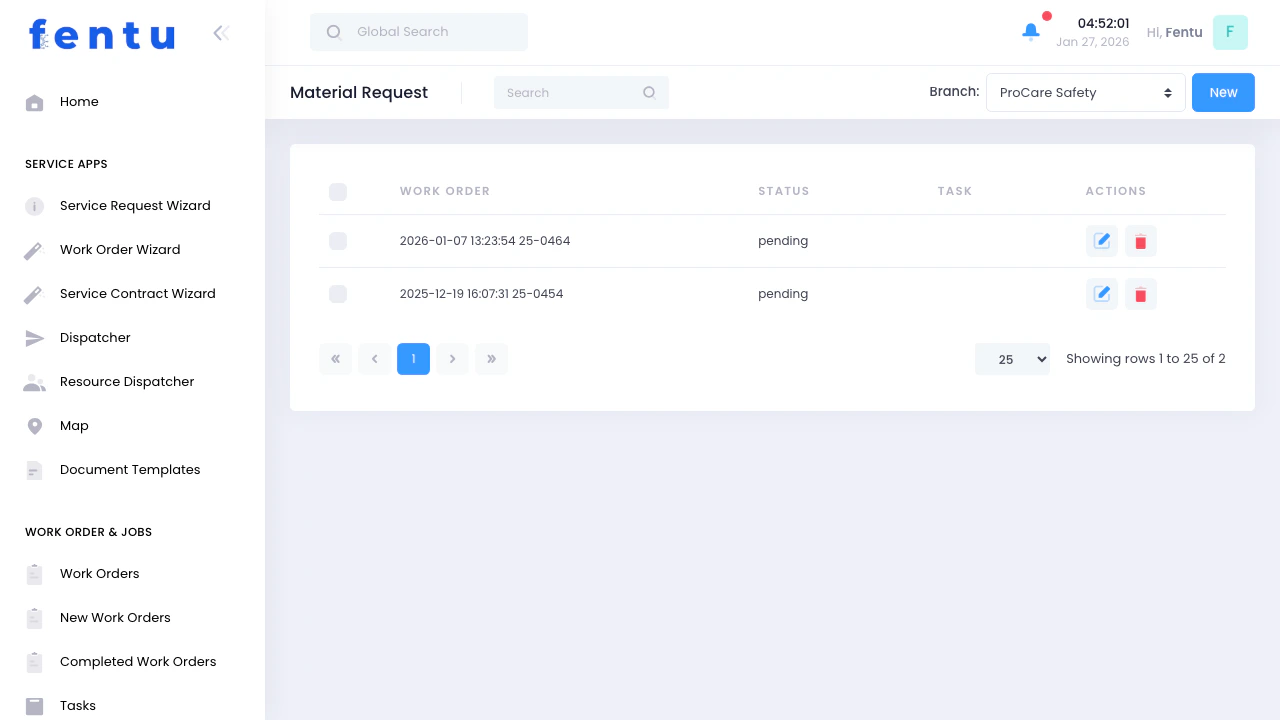 ## Overview
Time & Material is the execution and consumption layer for work orders. It tracks all materials, parts, and labor used during service execution.
Each entry is always linked to a **Work Order Task and a Service Object**, ensuring full traceability of cost, consumption, and billing.
Time & Material ensures that all consumed time and materials are tracked consistently and can be transferred to ERP systems for billing and cost control.
***
## When to Use Time & Material
Time & Material is used when:
* Technicians consume parts during execution
* Labor time must be tracked for billing or reporting
* Materials are used for repairs or installations
* Costs must be allocated to Service Objects
* Work needs to be transferred to ERP for invoicing
***
## Core Rule: Service Object Assignment
Every Time & Material entry must be assigned to a Service Object.
This ensures:
* Accurate cost allocation per Service Object
* Transparent labor and material tracking
* Correct ERP billing structure
* Full traceability of consumption
***
## Time & Material Structure
Each Work Order Task can contain multiple Time & Material entries:
| Type | Description |
| --------- | --------------------------------------- |
| Time | Labor effort (billable or non-billable) |
| Materials | Parts, components, consumables |
| Services | External or internal service costs |
***
## Time as a Billable Item
Time is treated as a first-class billing component:
* Time is recorded per Service Object
* Time can be billable or non-billable
* Time entries follow ERP costing rules
* Time is aggregated with material consumption
Time is handled in the same way as materials in ERP systems to ensure unified costing and invoicing.
***
## Creating Time & Material Entries
### From Work Orders
Navigate to the task being executed
Every entry must be linked to a Service Object
Record technician labor time
Select parts and quantities used
Validate all entries for posting
***
## Entry Details
Each Time & Material entry includes:
| Field | Description |
| --------------- | ---------------------------- |
| Service Object | Required assignment target |
| Work Order Task | Execution context |
| Type | Time, Material, or Service |
| Quantity | Time hours or material units |
| Unit Cost | Cost per unit/hour |
| Total Cost | Calculated total |
| Technician | Person performing work |
| Notes | Execution details |
***
## Consumption Process
When Time & Material is recorded:
* Time & Material are logged per Service Object
* Inventory Items / Materials are consumed from inventory
* Costs are allocated to Work Order Task
* Data is prepared for ERP posting
***
## ERP Integration
When ERP integration is enabled:
| Feature | Description |
| ----------------- | --------------------------------------------- |
| Inventory Posting | Materials are deducted from stock |
| Labor Posting | Time entries are transferred as service costs |
| Cost Allocation | All costs are assigned per Service Object |
| Billing Export | Data is prepared for invoicing |
Time & Material entries are the primary source for ERP billing and cost reporting.
***
## Best Practices
Create material requests as soon as you know what's needed. Early requests prevent scheduling delays and improve planning.
Include detailed part descriptions, numbers, and specifications. Vague requests lead to wrong parts and wasted time.
Search inventory before requesting. You might already have the part in stock at your warehouse or another branch.
Always link requests to work orders. This helps with cost tracking, approvals, and parts assignment.
Reserve urgent priority for true emergencies. Routine requests should be normal priority.
Add notes about why parts are needed, acceptable substitutions, and any special requirements.
Monitor expected delivery dates. Follow up on late shipments before they delay work orders.
Inspect all received parts immediately. Report discrepancies or damages to suppliers promptly.
Add received parts to inventory right away. Accurate inventory prevents duplicate orders.
***
## Common Questions
Yes, for stock replenishment or future needs. However, linking to a work order helps with cost tracking and approval.
You can add custom items to material requests. Include detailed description, supplier information, and estimated cost.
Update the request to show what was received. Create a new request for remaining items or note backorder status.
Depends on your system configuration. Some allow edits to approved requests, others require creating a new request. Check with your administrator.
Reject the shipment or note the discrepancy. Contact the supplier for return/exchange. Update the material request status accordingly.
Keep received requests for accounting and audit purposes. Your organization may have retention policies (typically 1-7 years).
Yes, but check existing requests first to avoid duplicates. Consolidating requests can reduce shipping costs.
Review the rejection reason. If still needed, provide additional justification and resubmit, or discuss with the approver.
***
## Related Documentation
Creating and managing work orders
Managing inventory and parts
Creating quotes for customer approval
Purchasing and procurement processes
## Overview
Time & Material is the execution and consumption layer for work orders. It tracks all materials, parts, and labor used during service execution.
Each entry is always linked to a **Work Order Task and a Service Object**, ensuring full traceability of cost, consumption, and billing.
Time & Material ensures that all consumed time and materials are tracked consistently and can be transferred to ERP systems for billing and cost control.
***
## When to Use Time & Material
Time & Material is used when:
* Technicians consume parts during execution
* Labor time must be tracked for billing or reporting
* Materials are used for repairs or installations
* Costs must be allocated to Service Objects
* Work needs to be transferred to ERP for invoicing
***
## Core Rule: Service Object Assignment
Every Time & Material entry must be assigned to a Service Object.
This ensures:
* Accurate cost allocation per Service Object
* Transparent labor and material tracking
* Correct ERP billing structure
* Full traceability of consumption
***
## Time & Material Structure
Each Work Order Task can contain multiple Time & Material entries:
| Type | Description |
| --------- | --------------------------------------- |
| Time | Labor effort (billable or non-billable) |
| Materials | Parts, components, consumables |
| Services | External or internal service costs |
***
## Time as a Billable Item
Time is treated as a first-class billing component:
* Time is recorded per Service Object
* Time can be billable or non-billable
* Time entries follow ERP costing rules
* Time is aggregated with material consumption
Time is handled in the same way as materials in ERP systems to ensure unified costing and invoicing.
***
## Creating Time & Material Entries
### From Work Orders
Navigate to the task being executed
Every entry must be linked to a Service Object
Record technician labor time
Select parts and quantities used
Validate all entries for posting
***
## Entry Details
Each Time & Material entry includes:
| Field | Description |
| --------------- | ---------------------------- |
| Service Object | Required assignment target |
| Work Order Task | Execution context |
| Type | Time, Material, or Service |
| Quantity | Time hours or material units |
| Unit Cost | Cost per unit/hour |
| Total Cost | Calculated total |
| Technician | Person performing work |
| Notes | Execution details |
***
## Consumption Process
When Time & Material is recorded:
* Time & Material are logged per Service Object
* Inventory Items / Materials are consumed from inventory
* Costs are allocated to Work Order Task
* Data is prepared for ERP posting
***
## ERP Integration
When ERP integration is enabled:
| Feature | Description |
| ----------------- | --------------------------------------------- |
| Inventory Posting | Materials are deducted from stock |
| Labor Posting | Time entries are transferred as service costs |
| Cost Allocation | All costs are assigned per Service Object |
| Billing Export | Data is prepared for invoicing |
Time & Material entries are the primary source for ERP billing and cost reporting.
***
## Best Practices
Create material requests as soon as you know what's needed. Early requests prevent scheduling delays and improve planning.
Include detailed part descriptions, numbers, and specifications. Vague requests lead to wrong parts and wasted time.
Search inventory before requesting. You might already have the part in stock at your warehouse or another branch.
Always link requests to work orders. This helps with cost tracking, approvals, and parts assignment.
Reserve urgent priority for true emergencies. Routine requests should be normal priority.
Add notes about why parts are needed, acceptable substitutions, and any special requirements.
Monitor expected delivery dates. Follow up on late shipments before they delay work orders.
Inspect all received parts immediately. Report discrepancies or damages to suppliers promptly.
Add received parts to inventory right away. Accurate inventory prevents duplicate orders.
***
## Common Questions
Yes, for stock replenishment or future needs. However, linking to a work order helps with cost tracking and approval.
You can add custom items to material requests. Include detailed description, supplier information, and estimated cost.
Update the request to show what was received. Create a new request for remaining items or note backorder status.
Depends on your system configuration. Some allow edits to approved requests, others require creating a new request. Check with your administrator.
Reject the shipment or note the discrepancy. Contact the supplier for return/exchange. Update the material request status accordingly.
Keep received requests for accounting and audit purposes. Your organization may have retention policies (typically 1-7 years).
Yes, but check existing requests first to avoid duplicates. Consolidating requests can reduce shipping costs.
Review the rejection reason. If still needed, provide additional justification and resubmit, or discuss with the approver.
***
## Related Documentation
Creating and managing work orders
Managing inventory and parts
Creating quotes for customer approval
Purchasing and procurement processes