
Overview
Inbound connections pull data FROM external systems INTO Fentu FSM. This is typically used for master data like customers, products, and inventory that originates in your ERP or CRM system.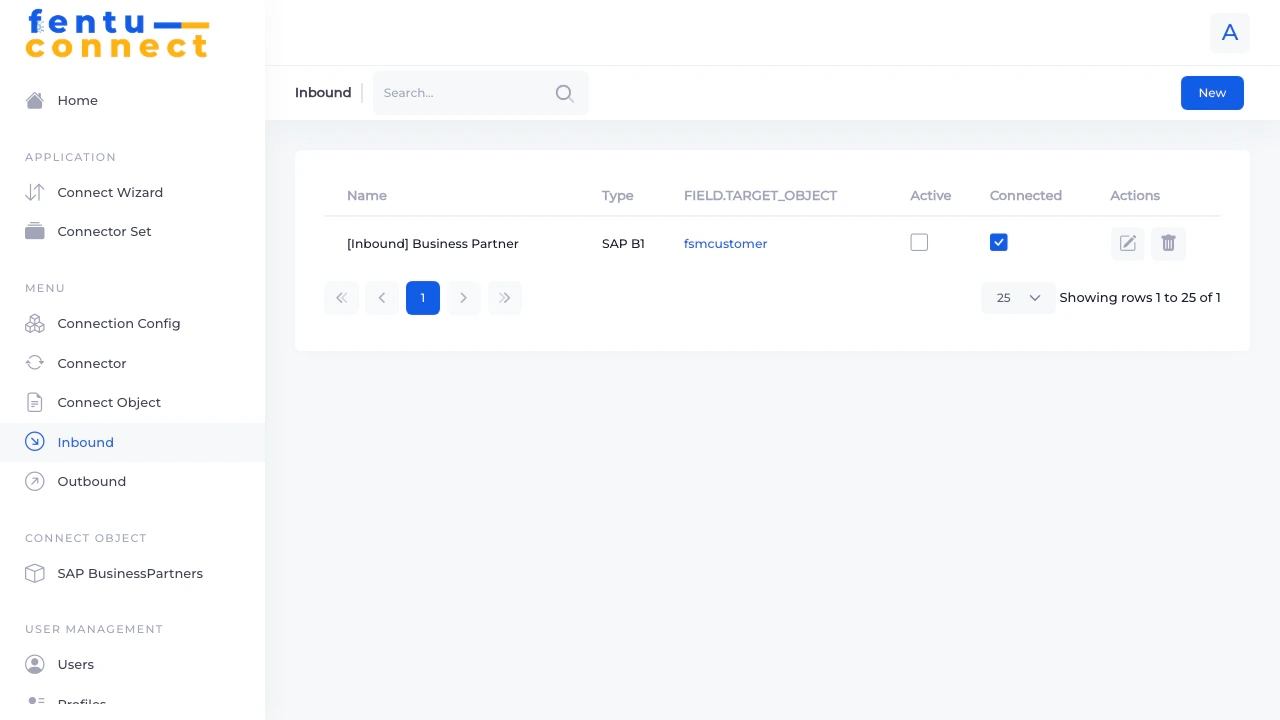
Inbound Connection List
The list displays all configured inbound connections:List Features
- Search - Filter connections by name
- New Button - Create a new inbound connection
- Pagination - Navigate through pages
- Items per Page - Choose display count
Inbound Connection Detail
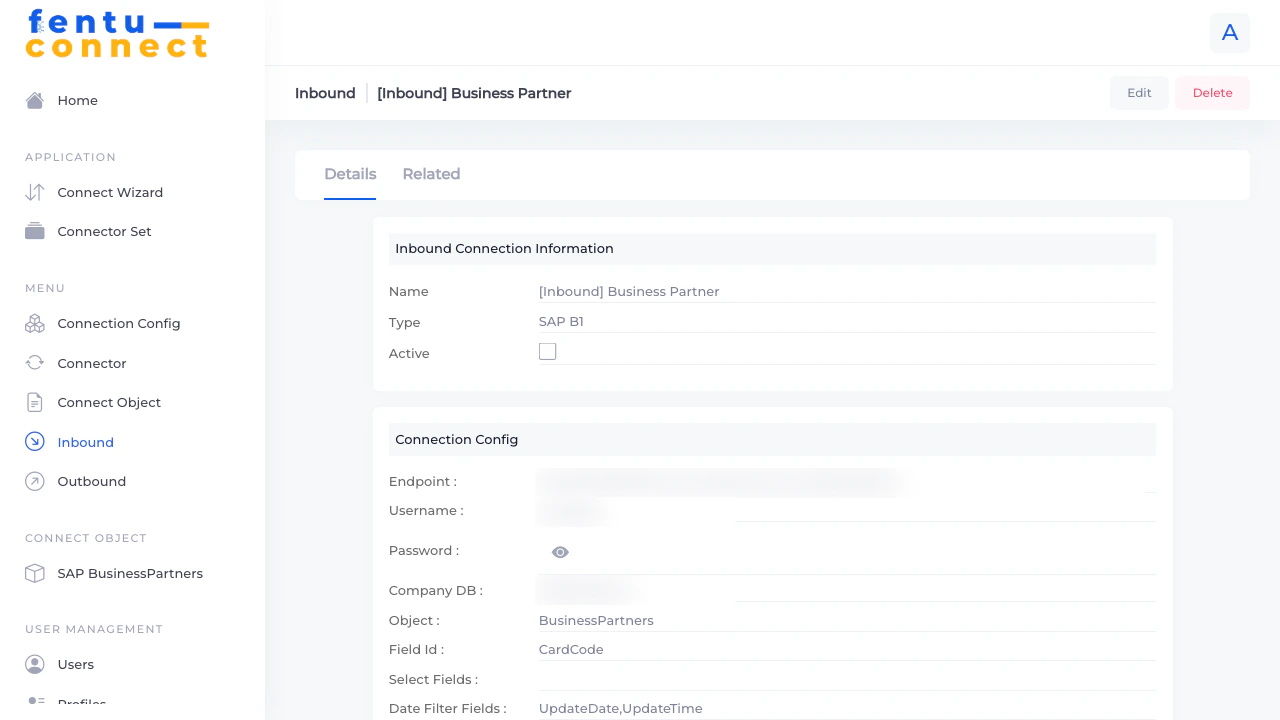
- Edit Button - Modify connection settings
- Delete Button - Remove the connection
- Details Tab - View connection configuration
- Related Tab - View related configurations
Details Tab
Shows all configuration settings for the inbound connection including:- Connection name and type
- Source and destination objects
- Activation status
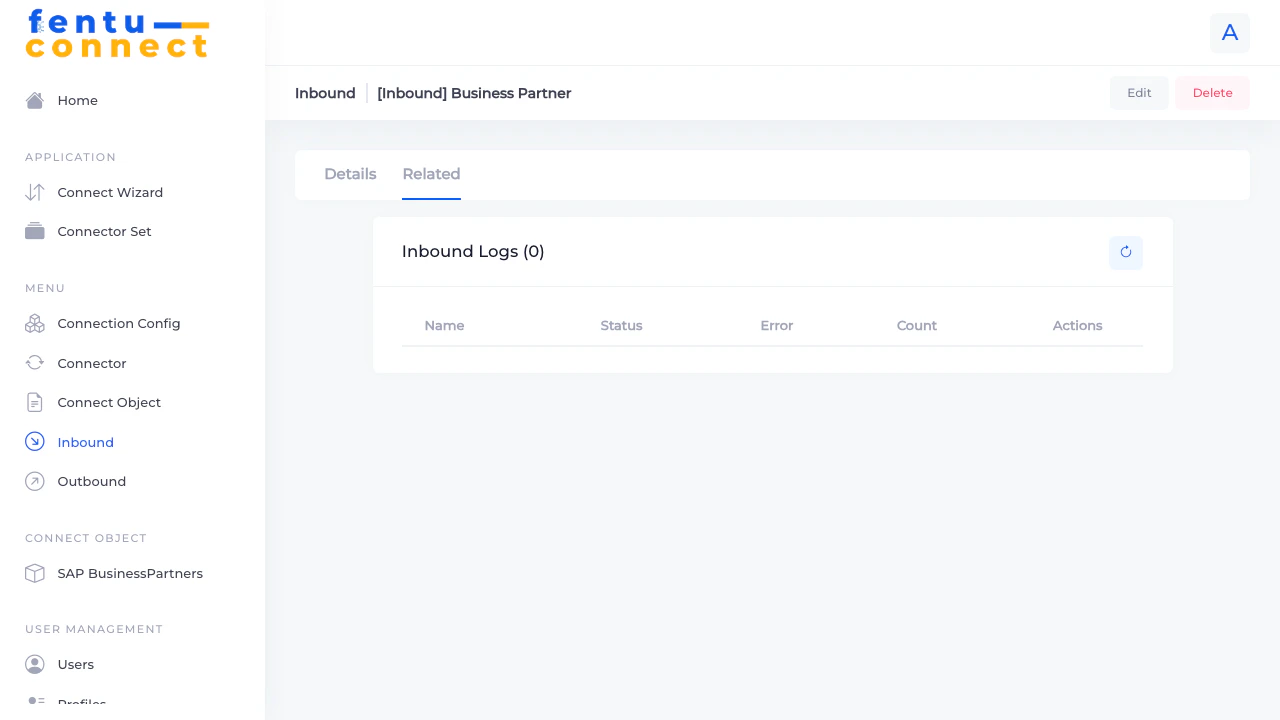
Related Tab
Creating an Inbound Connection
To create a new inbound connection:- Click New from the Inbound list
- Configure the connection settings
- Set up field mappings
- Click Save
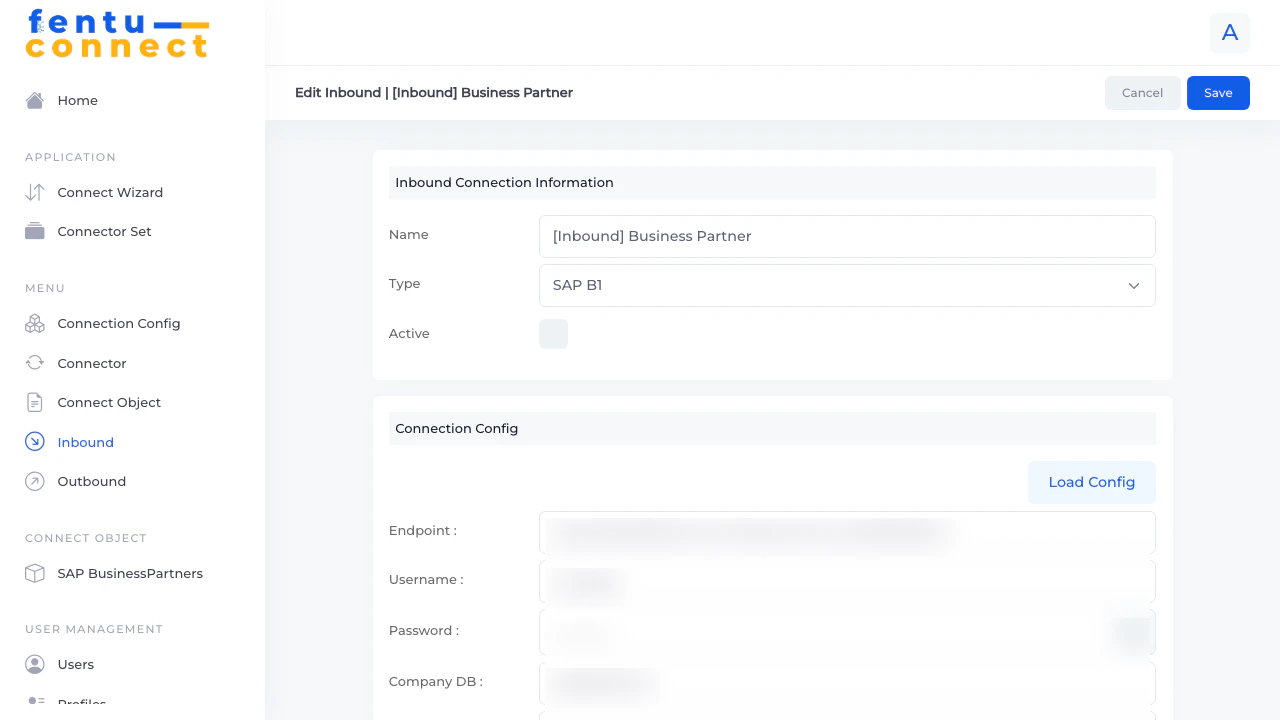
Editing an Inbound Connection
Basic Settings
Connection Settings
Click Load Config to load saved connection configurations.
Additional fields vary by system type:
Click Re-Connect to test the connection with current settings.
Object Mapping
Field Mapping Configuration
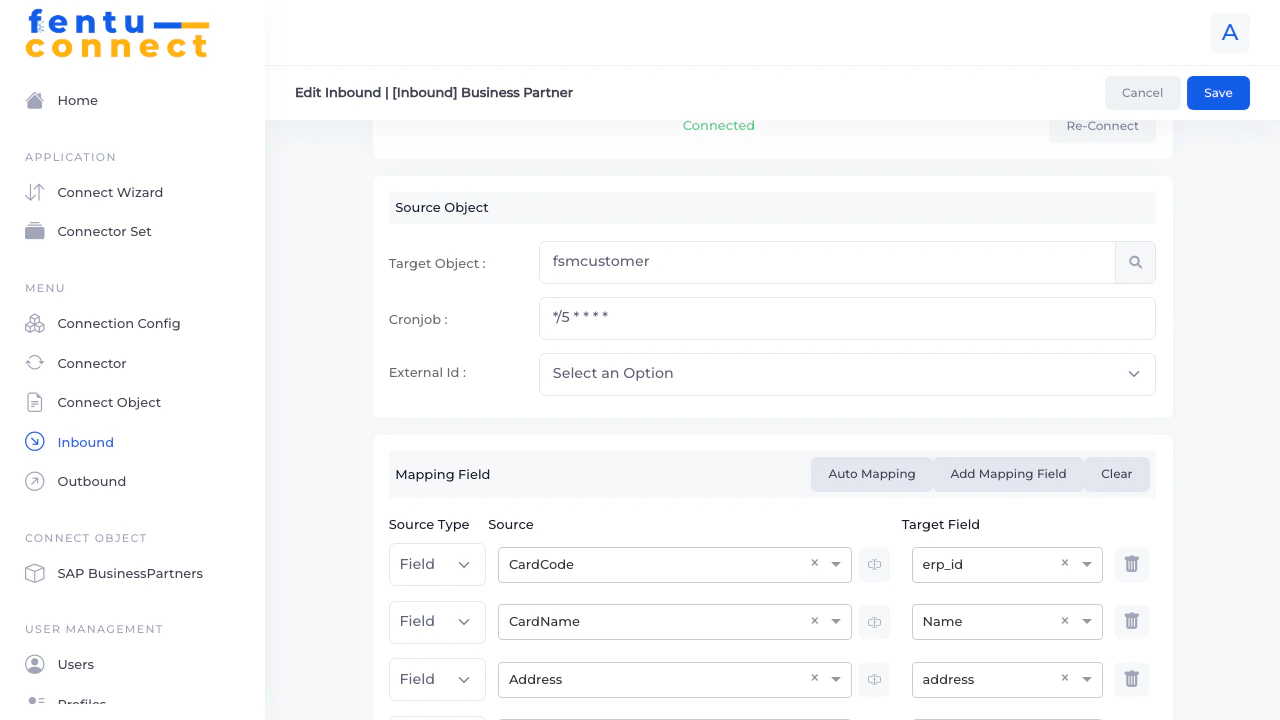
Mapping Controls
Mapping Row Structure
Each mapping row contains:Mapping Types
Field
Direct field-to-field mapping. Select a source field from the dropdown.
Raw Data
Static value that applies to all records. Enter the value directly.
Formula
Calculated value using formula syntax. See Formula Reference.
Destination Fields
The destination dropdown shows all fields from the selected Connect Object: Common Fentu FSM customer fields include:Name,address,descriptionbilling_address,billing_city,billing_country,billing_state,billing_street,billing_zipshipping_address,shipping_city,shipping_country,shipping_state,shipping_street,shipping_zipemail,phone,phone_mobile,faxcustomer_id,erp_id,external_idtype,industry,rating- Array fields:
BPAddresses,ContactEmployees,BPPaymentMethods
Working with Array Fields
Some external systems return nested arrays (like multiple addresses or contacts). Handle these with:- Array Fields - Map the entire array to an array field in the Connect Object
- Formulas - Use
findvalue()to extract specific values from arrays
Best Practices
Map Primary Key First
Map Primary Key First
Always configure the Primary Key Field correctly. This field is used to:
- Match existing records for updates
- Prevent duplicate record creation
- Track record relationships
Test Before Activating
Test Before Activating
Leave the connection inactive while configuring. Use the Re-Connect button to verify credentials work before enabling live synchronization.
Use Query Filters
Use Query Filters
When the external system has large datasets, use Query Filters to limit which records sync. This improves performance and reduces unnecessary data transfer.
Start with Essential Fields
Start with Essential Fields
Begin by mapping only essential fields. Add more mappings gradually as needed rather than trying to map everything at once.
Handle Nulls Appropriately
Handle Nulls Appropriately
Decide how to handle null/empty values from the source system. Use formulas like
ifempty() to provide defaults when needed.Common Questions
How often does inbound sync run?
How often does inbound sync run?
Sync frequency depends on your configuration. Check with your administrator for the scheduled sync intervals.
What happens if a record already exists?
What happens if a record already exists?
Records are matched using the Primary Key Field. If a match is found, the existing record is updated. If no match, a new record is created.
Can I sync only changed records?
Can I sync only changed records?
Yes, use Query Filters to filter by modification date or change flags in the source system to sync only records that have changed.
What if the connection fails mid-sync?
What if the connection fails mid-sync?
Fentu Connect handles connection failures gracefully. Records that synced before the failure remain, and the sync can be retried.
Troubleshooting
Records Not Syncing
Records Not Syncing
Check:
- Is the connection Active?
- Are connection credentials valid? (Test with Re-Connect)
- Does the Query Filter exclude the expected records?
- Is the Primary Key Field correctly configured?
Duplicate Records Created
Duplicate Records Created
Cause: Primary Key Field not matching correctlySolution:
- Verify the Primary Key Field contains unique values
- Check the field mapping for the primary key is correct
- Ensure the source field name matches exactly
Field Values Not Updating
Field Values Not Updating
Check:
- Is the field mapping configured correctly?
- For formula mappings, is the formula syntax correct?
- Does the destination field exist in the Connect Object?
Related Documentation
Outbound Connections
Configure outbound data push to external systems
Connect Objects
Define data structures for integration
Formula Reference
Learn formula syntax for data transformation
Connection Config
Configure connection credentials