
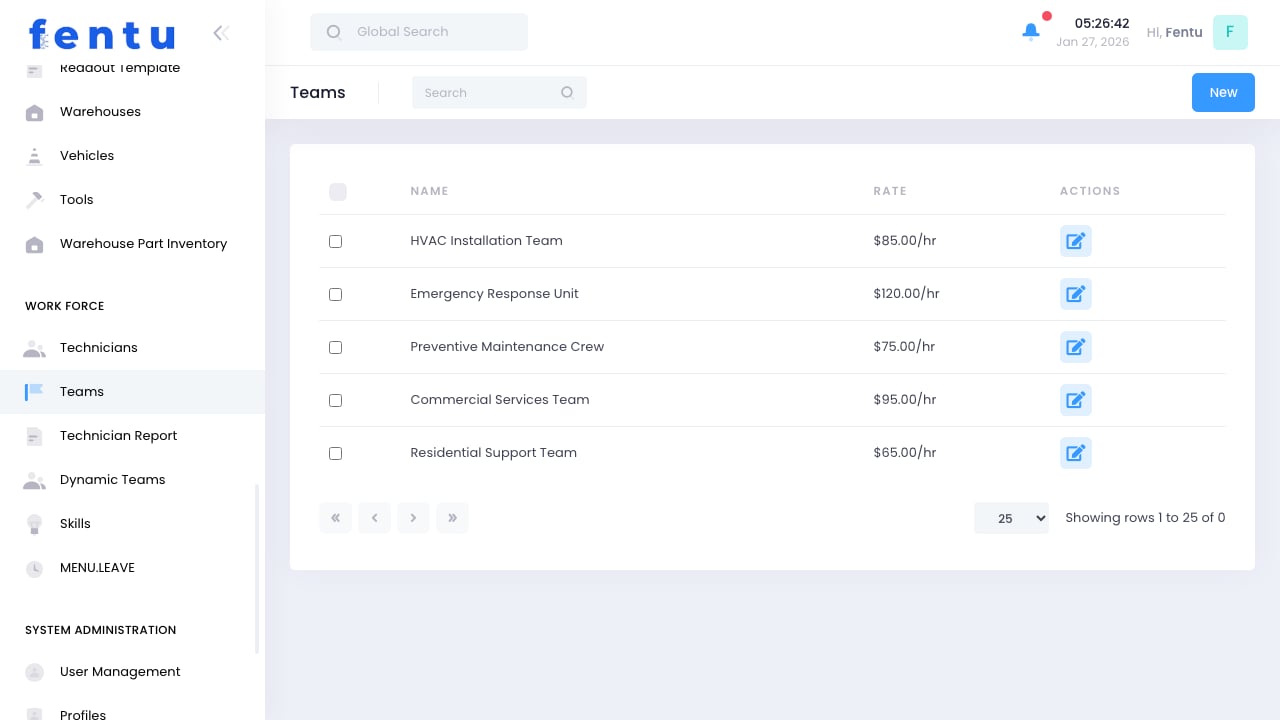
Overview
Teams group technicians together for organizational and operational purposes. Teams can be based on geography, specialty, management structure, or any other logical grouping that supports your dispatch and management needs.Well-structured teams simplify dispatch by allowing work to be assigned to a team rather than specific technicians. The dispatcher or system can then select the best available technician from the team.
When to Use Teams
Create teams for:- Geographic Coverage - Technicians serving a specific area
- Skill Specialization - Groups with particular expertise
- Management Structure - Reporting hierarchies
- Dispatch Groups - Flexible work assignment
- Shift Coverage - Day shift, night shift, weekend teams
Team Information
Each team includes:Team Types
Creating Teams
1
Navigate to Teams
Go to Workforce > Teams
2
Click Create
Start a new team
3
Enter Team Details
Provide name, code, and description
4
Assign Team Leader
Select the team supervisor
5
Set Branch Association
Link to service branch
6
Define Service Area
Set geographic boundaries if applicable
7
Add Team Members
Select technicians to include
8
Save Team
Save the team configuration
Adding Team Members
1
Open Team
Select the team to modify
2
Go to Members Section
Navigate to team membership
3
Click Add Member
Open member selection
4
Select Technicians
Choose technicians to add
5
Save Changes
Confirm the additions
Team Dispatch
Assignment Methods
Dispatch Priority
When assigning to a team, consider:- Skill Match - Does the technician have required skills?
- Availability - Is the technician available at the needed time?
- Location - How far is the technician from the job site?
- Workload - Is the technician already overloaded?
Configure dispatch rules to automatically select the best technician based on your priority criteria.
Managing Teams
Team Performance
Monitor team metrics:- Work orders completed
- First-time fix rate
- Average response time
- Customer satisfaction
- Utilization rate
Workload Balancing
Ensure even distribution:- Review individual workloads within team
- Transfer work between team members
- Adjust territories if imbalanced
- Add capacity if consistently overloaded
Coverage Planning
Ensure adequate coverage:- Track skill coverage across team
- Plan for absences and leave
- Cross-train for backup coverage
- Maintain minimum staffing levels
Best Practices
Clear Boundaries
Clear Boundaries
Define clear team boundaries, whether geographic or skill-based. Overlapping responsibilities cause confusion.
Appropriate Size
Appropriate Size
Teams should be large enough for coverage but small enough for manageable communication. Typically 5-15 members.
Skill Diversity
Skill Diversity
Ensure each team has diverse skills for coverage. Don’t put all experts in one team.
Empowered Leaders
Empowered Leaders
Give team leaders authority to manage their teams. They’re closest to the work.
Regular Review
Regular Review
Review team structure periodically. Adjust as your business and workforce change.
Clear Communication
Clear Communication
Establish communication channels for each team. Team chat, regular meetings, etc.
Common Questions
Can a technician be on multiple teams?
Can a technician be on multiple teams?
Depending on configuration, technicians may belong to multiple teams. This is useful for technicians who cover multiple areas or have multiple specialties.
What happens when a team is deleted?
What happens when a team is deleted?
Team members remain as technicians but lose team association. Reassign them to other teams before or after deletion.
How do teams relate to branches?
How do teams relate to branches?
Teams are typically associated with one branch. Some organizations have teams that span branches for specialized work.
Can teams have sub-teams?
Can teams have sub-teams?
The standard structure is flat. For hierarchies, use management relationships or create team naming conventions.
How does dispatch know which team to use?
How does dispatch know which team to use?
Work orders can specify a team, or dispatch rules can automatically select teams based on job location, type, or other criteria.
What's the difference between teams and dynamic teams?
What's the difference between teams and dynamic teams?
Regular teams are static - you manually add and remove members. Dynamic teams use rules to automatically determine membership.
Related Documentation
Dynamic Teams
Rule-based team membership
Technicians
Managing technician profiles
Dispatcher
Work assignment
Skills
Skill management