
Overview

Assets represent equipment, machinery, or systems that require service, maintenance, or monitoring. Each asset record tracks detailed information about the equipment, including serial numbers, installation dates, warranty information, and complete service history. Assets List View
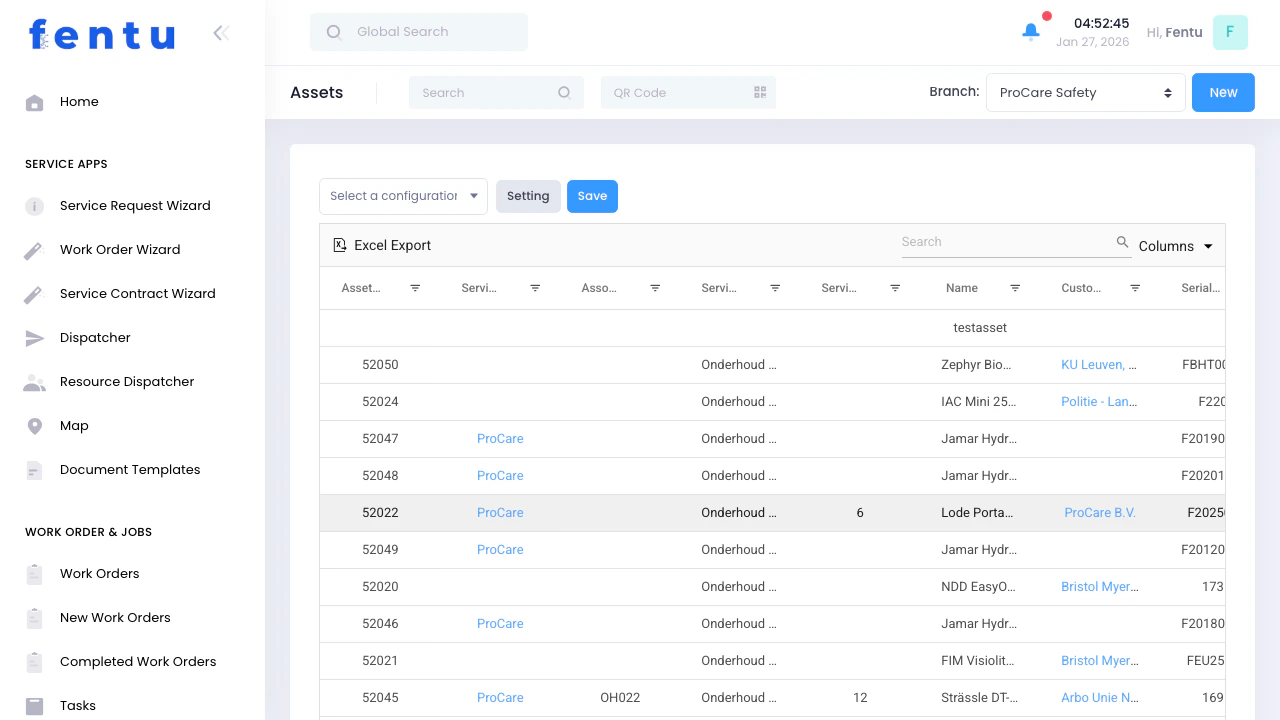
Assets are the core of preventive maintenance and service tracking. By maintaining detailed asset records, you can schedule proactive maintenance, track equipment lifecycles, and provide better service.

When to Use Assets

Use the Assets module when you need to:
  • Register new equipment for service tracking
  • Record asset details (serial number, model, installation date)
  • Schedule preventive maintenance
  • Track service history for specific equipment
  • Monitor warranty status and expiration dates
  • Plan equipment replacement based on age and condition
  • Generate asset-specific reports

Understanding Assets

Asset Hierarchy

Customer (Company)
  └─ Object (Location)
      └─ Asset (Equipment)
          └─ Asset Parts (Components)
Example:
  • Customer: “Acme Corporation”
    • Object: “Acme HQ Building”
      • Asset: “Rooftop HVAC Unit #1”
        • Asset Parts: Compressor, Condenser Coil, Evaporator Coil, Blower Motor
      • Asset: “Main Elevator”
        • Asset Parts: Motor, Control Panel, Door System

Assets in the Service Workflow

Assets are central to field service operations:
  1. Work Order Creation - Select the asset that needs service
  2. Task Assignment - Technicians service specific assets
  3. Preventive Maintenance - Schedule based on asset requirements
  4. Service History - Track all work performed on each asset
  5. Replacement Planning - Monitor asset age and condition

Assets List View

Key Features

Filter assets by branch to see equipment in your service area.
Visual indicators show asset status: Active, Under Maintenance, Out of Service, Retired.
Quickly identify assets with active warranties or upcoming warranty expirations.
See which assets have preventive maintenance coming due or overdue.

Asset List Columns

ColumnDescription
Asset NameDescriptive name for the equipment (click to view details)
Asset Code/IDUnique identifier assigned by Fentu
Serial NumberManufacturer serial number
ModelEquipment model number
TypeAsset type or category (HVAC, Elevator, Electrical, etc.)
CustomerWhich customer owns the asset
LocationWhich object (location) the asset is at
StatusCurrent operational status
Warranty StatusActive warranty indicator
Last ServiceDate of most recent service
Next ServiceScheduled preventive maintenance date
ActionsQuick links to view, edit, create work order

Creating a New Asset

1

Click 'New Asset'

Click the “New Asset” or ”+” button in the top right corner.
2

Select Customer and Location

Choose which customer owns the asset and at which object (location) it’s installed.
3

Enter Asset Details

Fill in equipment name, type, manufacturer, model, and serial number.
4

Add Installation Information

Document installation date, warranty info, and any special requirements.
5

Upload Documentation

Attach manuals, spec sheets, photos, or warranties (optional).
6

Save

Click “Save” to create the asset record.

Asset Information Fields

Basic Information

FieldDescription
Asset NameDescriptive name for the equipment. Use clear naming: “Rooftop HVAC Unit #1” not just “HVAC”. Required field.
Asset CodeUnique internal code or asset tag number. Use barcode labels for easy scanning.
Asset TypeCategory of equipment: HVAC, Electrical, Plumbing, Elevator, Mechanical, IT Equipment, etc. Required field.
StatusCurrent operational status: Active, Under Maintenance, Out of Service, Retired.
CustomerWhich customer owns or operates this asset. Required field.
Location (Object)Physical location where the asset is installed. Required field.
Zone/AreaSpecific area within the location: “Rooftop”, “Basement”, “Floor 3 East Wing”.
Use consistent naming conventions for assets. Include location identifiers in the name when multiple similar assets exist: “West Wing HVAC Unit” vs “East Wing HVAC Unit”.

Equipment Details

FieldDescription
ManufacturerEquipment manufacturer or brand name.
Model NumberSpecific model designation from manufacturer.
Serial NumberManufacturer serial number. Critical for warranty claims and part ordering.
Capacity/RatingEquipment capacity: tons for HVAC, horsepower for motors, BTU for heating, etc.
Year ManufacturedYear the equipment was manufactured (may differ from installation date).

Installation Information

FieldDescription
Installation DateWhen the asset was installed at its current location.
Commissioning DateWhen the asset was put into service and tested.
Installed ByCompany or contractor who performed installation.
Installation CostOriginal purchase and installation cost (for depreciation and replacement planning).

Warranty Information

FieldDescription
Warranty Start DateWhen warranty coverage begins.
Warranty End DateWhen warranty coverage expires. System can alert when warranty is ending.
Warranty TypeParts only, labor only, or comprehensive coverage.
Warranty ProviderManufacturer warranty or extended warranty provider.
Warranty NumberWarranty certificate or policy number.
Always verify warranty status before authorizing repairs. Performing unauthorized work on equipment under warranty can void coverage.

Maintenance Requirements

FieldDescription
Maintenance ScheduleHow often preventive maintenance is required: Monthly, Quarterly, Semi-Annual, Annual.
Last Service DateWhen the asset was last serviced.
Next Service DueWhen preventive maintenance is next scheduled.
Service IntervalNumber of days/months between preventive maintenance visits.
Estimated Annual HoursHow many hours per year the equipment operates (for hour-based maintenance).

Specifications

FieldDescription
VoltageElectrical voltage requirements.
PhaseSingle-phase or three-phase power.
AmperageElectrical current draw.
Refrigerant TypeFor HVAC equipment, type of refrigerant used.
DimensionsPhysical size of equipment (for replacement planning).
WeightEquipment weight (for rigging and installation planning).

Service Information

FieldDescription
Service PriorityCritical, High, Medium, Low. Determines response time for emergency calls.
Access RequirementsSpecial requirements to reach the asset: roof access, ladder, confined space, etc.
Safety RequirementsRequired safety equipment or procedures: lockout/tagout, confined space training, etc.
Special Tools RequiredSpecialized tools or test equipment needed for service.

Financial Information

FieldDescription
Purchase PriceOriginal purchase price.
Current ValueEstimated current value (for insurance and replacement planning).
Expected LifeExpected useful life in years.
Replacement CostEstimated cost to replace the asset today.

Documentation

FieldDescription
ManualsUpload operation manuals, maintenance manuals, and service guides.
Spec SheetsTechnical specification sheets from manufacturer.
DrawingsElectrical drawings, mechanical drawings, installation diagrams.
PhotosPhotos of equipment, location, nameplate, model/serial labels.
Warranty DocumentsUpload warranty certificates and extended warranty contracts.

Notes

FieldDescription
NotesInternal notes about the asset. Document quirks, common issues, modification history, or anything else technicians should know.
Technician InstructionsSpecific service instructions: “Must be shut down 24 hours before service” or “Requires 2 technicians for annual service”.
Take photos of asset nameplates showing model and serial numbers. Upload these photos to the asset record. This saves technicians time and prevents transcription errors when ordering parts.

Asset Types and Examples

Examples: Rooftop units, split systems, chillers, boilers, air handlers, exhaust fansKey Fields: Tonnage/capacity, refrigerant type, filter sizes, maintenance scheduleTypical Maintenance: Quarterly or semi-annual preventive maintenance
Examples: Passenger elevators, freight elevators, escalators, wheelchair liftsKey Fields: Capacity, speed, number of floors, controller typeTypical Maintenance: Monthly inspections (often required by code)
Examples: Transformers, switchgear, generators, UPS systems, lighting systemsKey Fields: Voltage, amperage, phase, backup runtimeTypical Maintenance: Annual testing, quarterly for critical systems
Examples: Water heaters, pumps, backflow preventers, grease traps, sewage ejectorsKey Fields: Capacity, pressure rating, temperature ratingTypical Maintenance: Annual inspections, some require quarterly service
Examples: Fire alarm panels, sprinkler systems, emergency lighting, fire extinguishersKey Fields: Inspection authority, certification dates, capacityTypical Maintenance: Code-required inspections (monthly, quarterly, annual)
Examples: Compressors, motors, pumps, fans, conveyorsKey Fields: Horsepower, RPM, duty cycle, bearing typeTypical Maintenance: Based on runtime hours or annually
Examples: Walk-in coolers, freezers, reach-in refrigerators, ice machinesKey Fields: Temperature range, refrigerant type, defrost typeTypical Maintenance: Quarterly to semi-annual

Asset Status Management

Status Types

Asset is operational and in normal use. This is the default status for most assets.
Asset is currently being serviced. Work order is open and technician is working on it.
Asset is not functioning and awaiting repair. May require emergency service or parts.
Asset has been removed from service permanently. No longer requires maintenance scheduling.
New asset still under manufacturer warranty period. All service should go through manufacturer.

Changing Asset Status

Asset status typically changes automatically based on work order status:
  • When a work order is opened → Status changes to “Under Maintenance”
  • When work order is completed → Status returns to “Active”
  • Out of service status can be set manually when equipment fails

Asset Actions

From the List View

View Details

Click the asset name to see complete information, service history, and related records.

Edit Asset

Update asset information, specifications, or maintenance schedule.

Create Work Order

Quickly create a work order for this specific asset.

View Service History

See all work orders, maintenance, and repairs performed on this asset.

Schedule Maintenance

Set up or modify preventive maintenance schedule.

Generate QR Code

Create QR code or barcode label for the asset for easy scanning.

From the Detail View

When viewing an asset record, you can:
  • See complete service history with dates, costs, and technician notes
  • View all asset parts (components)
  • Access uploaded documentation (manuals, photos, drawings)
  • Review warranty information and coverage
  • Check maintenance schedule and upcoming service dates
  • Generate asset-specific reports

Tips and Best Practices

When taking on a new customer, invest time in thorough asset documentation. Collect serial numbers, model numbers, installation dates, and photos. This upfront investment pays dividends in faster service delivery and better maintenance scheduling.
Apply physical asset tags (barcode or QR code labels) to equipment. Technicians can scan tags with mobile devices to instantly pull up asset history, manuals, and service notes. This eliminates confusion and saves time.
Take and upload photos of:
  • Equipment nameplate (model/serial number)
  • Overall equipment view
  • Location within building
  • Access points
  • Known issues or problem areas
Photos help new technicians quickly locate and identify equipment.
Set reminders for warranty expiration dates. Contact customers 60-90 days before warranty expires to discuss extended warranty or service contract options.
Use the notes field liberally. Document:
  • Common problems and solutions
  • Modification history
  • Part numbers for frequently replaced items
  • Special service procedures
  • Historical issues
This knowledge base helps technicians work more efficiently.
Review and adjust preventive maintenance schedules based on actual equipment needs. Some assets may need more frequent service; others less. Use service history to optimize schedules.
Establish asset naming conventions:
  • Include location: “Rooftop HVAC #1”
  • Use numbers for multiples: “Elevator A” vs “Elevator B”
  • Be specific: “West Parking Lot Light Pole #7” not just “Light”
Consistent naming prevents confusion and helps dispatchers assign the right technician.

Common Questions

Create assets for equipment that:
  • Requires regular maintenance
  • Has warranty coverage
  • Is expensive or critical to operations
  • Has a service history you want to track
You don’t need assets for small, disposable items (light bulbs, filters) unless tracking them provides value. Focus on equipment that matters to your service business.
Start with what you know and fill in details over time. The most important fields are:
  • Asset name and type
  • Customer and location
  • Serial number (if available)
Technicians can collect additional information (model number, specifications) during service visits and update the record.
Edit the asset record and change the Location (Object) field to reflect the new location. The asset’s complete service history moves with it, so you don’t lose any historical data.
Assets with service history should not be deleted. Instead, change the status to “Retired” and note the retirement date. This preserves historical data for reporting and analysis. Only delete assets that were created in error and have no service history.
Asset Type is the broad category: HVAC, Electrical, Plumbing, Elevator, etc. Category (if used in your setup) can be more specific: Rooftop Unit, Split System, Chiller (all HVAC types). Use the classification system that works for your business.
Set the maintenance interval in the asset record (e.g., “Every 3 months”). Fentu can automatically generate work orders based on these schedules, or you can manually create scheduled work orders. The system tracks “Last Service Date” and calculates “Next Service Due”.
Use the Asset Parts module to document major components. For consumable parts (filters, belts), link them to the asset type in your inventory system. This allows automated part recommendations when creating work orders for specific assets.

Asset Parts

Track individual components and parts of assets.

Objects (Locations)

Manage physical locations where assets are installed.

Work Order Wizard

Create work orders for asset service and maintenance.

Preventive Maintenance

Set up automated preventive maintenance schedules.