
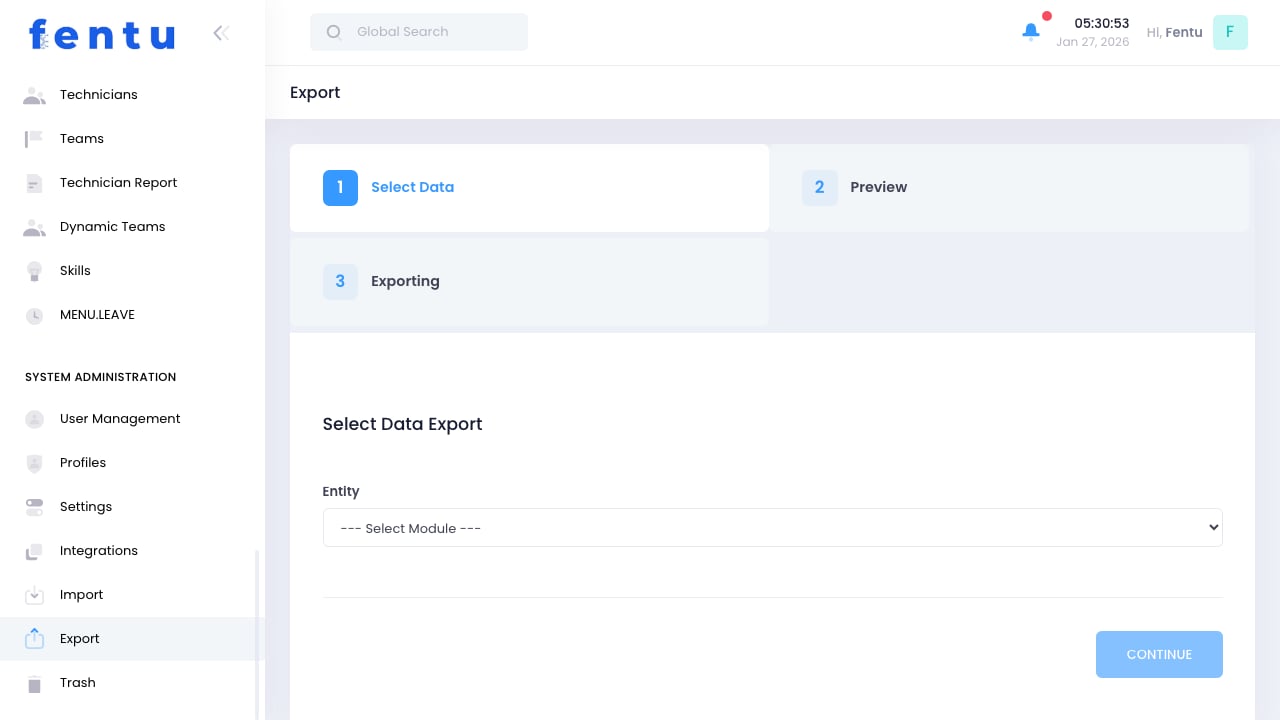
Overview
The Export function allows you to download data from Fentu FSM for use in external applications, reporting tools, or for backup purposes. Export provides flexibility in selecting what data to extract and in what format.Exports are point-in-time snapshots. For ongoing data feeds to external systems, consider using Integrations or the API instead.
When to Use Export
Use export for:- Reporting - Creating custom reports in Excel or other tools
- Analysis - Analyzing data in external applications
- Backup - Creating data backups
- Sharing - Providing data to stakeholders
- Migration - Moving data to another system
- Compliance - Meeting data request requirements
Exportable Data Types
Export Formats
Exporting Data
1
Navigate to Export
Go to Administration > Export
2
Select Data Type
Choose what data to export
3
Set Filters
Limit data by date range, status, etc.
4
Select Fields
Choose which fields to include
5
Choose Format
Select output format
6
Run Export
Generate the export file
7
Download
Download the generated file
Filtering Options
Field Selection
Choosing Fields
- Select all fields for complete export
- Choose specific fields to limit data
- Required fields may be auto-included
- Related fields can be included (e.g., customer name on work orders)
Field Categories
Include Related Data
Options to include:- Customer name and details on work orders
- Product information on line items
- Technician name on tasks
- Address details with locations
Export Scheduling
Scheduled Exports
For regular exports:- Create export definition
- Set schedule (daily, weekly, monthly)
- Configure delivery (email, FTP)
- Activate schedule
Scheduled Export Settings
Scheduled exports use dynamic date filters (e.g., “last 7 days”) that update each run.
Large Exports
For exports with many records:Performance Considerations
- Exports run in background for large datasets
- Notification sent when complete
- Download link provided
- Files available for limited time
Best Practices for Large Exports
- Apply filters to reduce size
- Limit fields to what’s needed
- Schedule during off-hours
- Split into multiple smaller exports
Export Limits
Security & Permissions
Export Permissions
Data Protection
- Exports may exclude sensitive fields
- Audit log records all exports
- Permissions control what users can export
- Consider data classification before exporting
Best Practices
Filter First
Filter First
Always apply appropriate filters. Exporting everything is rarely necessary or useful.
Select Needed Fields
Select Needed Fields
Export only the fields you need. Smaller exports are faster and easier to work with.
Choose Right Format
Choose Right Format
Use Excel for analysis, CSV for imports elsewhere, PDF for sharing.
Document Exports
Document Exports
Keep records of what was exported, when, and why. Important for compliance.
Secure Export Files
Secure Export Files
Treat export files as confidential. Don’t leave them on shared drives indefinitely.
Use Schedules for Regular Needs
Use Schedules for Regular Needs
Set up scheduled exports for regular reporting needs instead of manual exports.
Common Questions
How long are export files available?
How long are export files available?
Typically 7-30 days depending on configuration. Download promptly or set up scheduled delivery.
Can I export deleted records?
Can I export deleted records?
Not directly. Deleted records are in Trash. Export from Trash if needed before permanent deletion.
Why is my export missing records?
Why is my export missing records?
Check filters. Records may be excluded by date range, status, branch, or other filters.
Can I export to Google Sheets?
Can I export to Google Sheets?
Export to Excel or CSV, then import to Google Sheets. Direct export to Google Sheets isn’t supported.
Are custom fields included?
Are custom fields included?
Yes, custom fields can be selected for export along with standard fields.
Who can see my scheduled exports?
Who can see my scheduled exports?
Administrators can see all scheduled exports. Regular users see only their own.
Related Documentation
Import
Importing data
API Reference
Programmatic data access
Integrations
Automated data sync
Profiles
Export permissions